Court hearings represent the cornerstone of judicial proceedings, where legal disputes are formally resolved through structured processes that have evolved over centuries. Understanding what happens during these proceedings is essential for anyone involved in litigation, whether as a party, witness, or legal representative. The complexity of modern court hearings extends far beyond the traditional image of dramatic courtroom exchanges, encompassing intricate procedural requirements, evidence management, and sophisticated legal protocols.
The judicial system in England and Wales operates through a carefully orchestrated framework that ensures fairness, transparency, and adherence to established legal principles. From pre-hearing preparations to post-judgment procedures, each stage serves a specific purpose in delivering justice. Whether you’re facing a civil dispute, criminal charges, or tribunal proceedings, the fundamental structure remains consistent whilst accommodating the unique requirements of different case types.
Pre-hearing procedural requirements and documentation
The foundation of any successful court hearing lies in meticulous preparation and compliance with procedural requirements. This preparatory phase can span several months, particularly in complex litigation, and involves multiple stakeholders working to ensure all necessary documentation is properly prepared and filed within prescribed timeframes.
Case management conference scheduling and directions
Case management conferences serve as the administrative backbone of court proceedings, establishing timelines and procedural requirements that govern the entire litigation process. During these conferences, judges issue specific directions regarding disclosure deadlines, witness statement exchanges, and expert evidence requirements. The court’s primary objective is to ensure cases progress efficiently whilst maintaining procedural fairness for all parties involved.
These conferences typically occur several weeks before the main hearing, allowing sufficient time for parties to comply with directions. Failure to adhere to case management directions can result in sanctions, including cost penalties or even case dismissal in extreme circumstances. The judge will consider the complexity of the case, availability of witnesses, and court scheduling when establishing timelines.
Witness statement disclosure under CPR part 32
Witness statements form a crucial component of court hearings, providing detailed accounts of relevant events from individuals with direct knowledge of the circumstances. Under Civil Procedure Rules Part 32, witness statements must be disclosed within specified timeframes, typically several weeks before the hearing date. These statements serve as evidence-in-chief, meaning witnesses cannot generally expand upon their written testimony during oral examination.
The preparation of witness statements requires careful attention to detail, ensuring accuracy, relevance, and compliance with procedural requirements. Witnesses must confirm the truthfulness of their statements through formal declarations, and any subsequent changes require court approval. Legal representatives play a vital role in guiding witnesses through this process whilst ensuring statements meet evidential standards.
Bundles preparation according to practice direction 39A
Court bundles represent comprehensive collections of all relevant documents that will be referenced during hearings. Practice Direction 39A establishes specific requirements for bundle preparation, including chronological organisation, consistent pagination, and proper indexing. These bundles ensure judges and all parties have immediate access to relevant documentation during proceedings.
The responsibility for bundle preparation typically falls to the claimant’s legal team, though all parties must cooperate to ensure completeness and accuracy. Electronic bundles are increasingly common, particularly following technological advances accelerated by the pandemic. Proper bundle preparation significantly enhances hearing efficiency and reduces the likelihood of adjournments due to missing documentation.
Legal representation certificates and rights of audience
Legal representation during court hearings requires proper certification and rights of audience, which vary depending on the court level and case complexity. Solicitors automatically possess rights of audience in lower courts, whilst higher court appearances may require barristers or solicitor-advocates with appropriate qualifications. These requirements ensure professional competency and maintain courtroom standards.
Clients may choose to represent themselves (acting as litigants in person), though this approach presents significant challenges given the complexity of legal procedures and evidential rules. Courts provide some assistance to unrepresented parties, but the fundamental principle remains that individuals are responsible for presenting their own cases effectively.
Court hearing commencement and judicial protocol
The formal commencement of court hearings follows established protocols designed to maintain dignity, order, and respect for the judicial process. These traditions, whilst sometimes appearing antiquated, serve important functions in establishing the sol
emnity and neutrality of the court, reinforcing that all participants are subject to the same rules and decorum.
Case calling and attendance registration procedures
At the start of a court hearing, the usher or court clerk will call the case in the waiting area, usually by announcing the case name and number. Parties, legal representatives, and witnesses are then directed into the courtroom and their attendance is formally recorded. This process ensures the judge knows who is present, whether any parties are absent, and if any applications relating to non-attendance or adjournments may be required.
Before the substantive hearing begins, the court will typically confirm the identities of the parties and their representatives on the record. You can expect to be asked to state your name and role in the case, particularly if you are a litigant in person. Where interpreters, McKenzie Friends, or support workers are present, their roles are also clarified to ensure that the judge understands who will be addressing the court and who is there purely in a supportive capacity.
Attendance registration also allows the judge to confirm whether all necessary witnesses are available and whether any are giving evidence via video link or telephone. If a key witness is unexpectedly absent, this may trigger immediate case management discussions, including whether to proceed, adjourn, or rely on written evidence. This initial check helps avoid disruption later in the hearing and supports efficient use of court time.
Judicial identification and courtroom hierarchy establishment
Once the parties are assembled, the judge or magistrates enter the courtroom, usually announced by the usher with the words “All rise.” This signals the formal beginning of the hearing and reinforces respect for the authority of the court. After everyone is invited to sit, the judge will typically introduce themselves by their judicial title and may confirm the type of hearing taking place, for example a trial, case management hearing, or sentencing.
Understanding courtroom hierarchy is important, particularly if you are unfamiliar with legal proceedings. In the Magistrates’ Court, decisions are made by either a District Judge or a bench of lay magistrates assisted by a legal adviser. In the Crown Court, a judge presides over the hearing, while a jury may be present in criminal trials. In civil courts, such as the County Court or High Court, judges of varying seniority oversee proceedings depending on the complexity and value of the claim.
Parties and representatives are expected to address the judge using the appropriate form of address, such as “Judge,” “Your Honour,” or “Sir/Madam,” depending on the court. This may feel formal, but it helps maintain clarity and order, particularly during complex hearings. The judge’s role is to manage the hearing, decide legal issues, and ultimately determine the outcome; all questions, submissions, and applications should therefore be directed to them rather than to the opposing party.
Preliminary applications and housekeeping matters
Before turning to the core issues of the case, the court will usually deal with preliminary or “housekeeping” matters. These can include confirming that all parties have the same version of the hearing bundle, addressing any late evidence, resolving timetable questions, and clarifying which witnesses will be called. If you or your legal representative wish to raise any procedural issues—such as an application for an adjournment, special measures for a vulnerable witness, or permission to rely on late documents—this is often the point at which they will be dealt with.
Preliminary applications might seem minor, but they can significantly affect how smoothly the hearing runs. For example, if you intend to rely on video evidence or remote testimony, the court must ensure that the necessary technology is in place and functioning. Similarly, if there is a dispute about the admissibility of certain documents or expert reports, the judge may make rulings at this stage, shaping the scope of evidence that can be explored later.
Courts are increasingly strict about compliance with earlier case management directions, and judges may refuse late applications or impose cost sanctions where there is no good reason for delay. From your perspective, preparing any housekeeping issues in advance and communicating them clearly to the court can prevent unnecessary disruption. Think of this stage as setting the “ground rules” for the rest of the hearing.
Opening statement protocols for claimant representation
Once preliminary matters are resolved, the hearing moves to opening statements, usually starting with the claimant (or prosecution in criminal cases). The purpose of an opening statement is not to argue the entire case in detail, but to provide the judge with a clear roadmap of the issues, the key evidence, and the outcome the claimant seeks. A well-structured opening helps the court understand how the subsequent evidence fits into the broader narrative.
In civil hearings, the claimant’s representative will typically summarise the factual background, identify the legal basis of the claim, and highlight any agreed or disputed issues. They may also refer briefly to the main documents or witness statements, indicating where in the bundle the judge can find them. In criminal trials, the prosecutor’s opening sets out the alleged offences, the sequence of events, and the main strands of evidence they say prove guilt.
If you are representing yourself, you are still entitled to make an opening statement, although the court may not expect the same level of formality. Focus on explaining, in a concise and logical way, what your case is about and what you want the court to decide. Think of it as giving the judge a structured summary so that, as the hearing unfolds, they can see how each piece of evidence fits into your overall position.
Evidence presentation and cross-examination procedures
Once openings are complete, the hearing moves into the evidential stage, where facts are established through witness testimony, documents, and expert reports. This is the point at which the court hearing most closely resembles the traditional courtroom scenes you may have seen on television, though in practice the process is more controlled and methodical. The rules of evidence aim to ensure that only reliable, relevant material is considered.
Witness box oath administration and affirmation alternatives
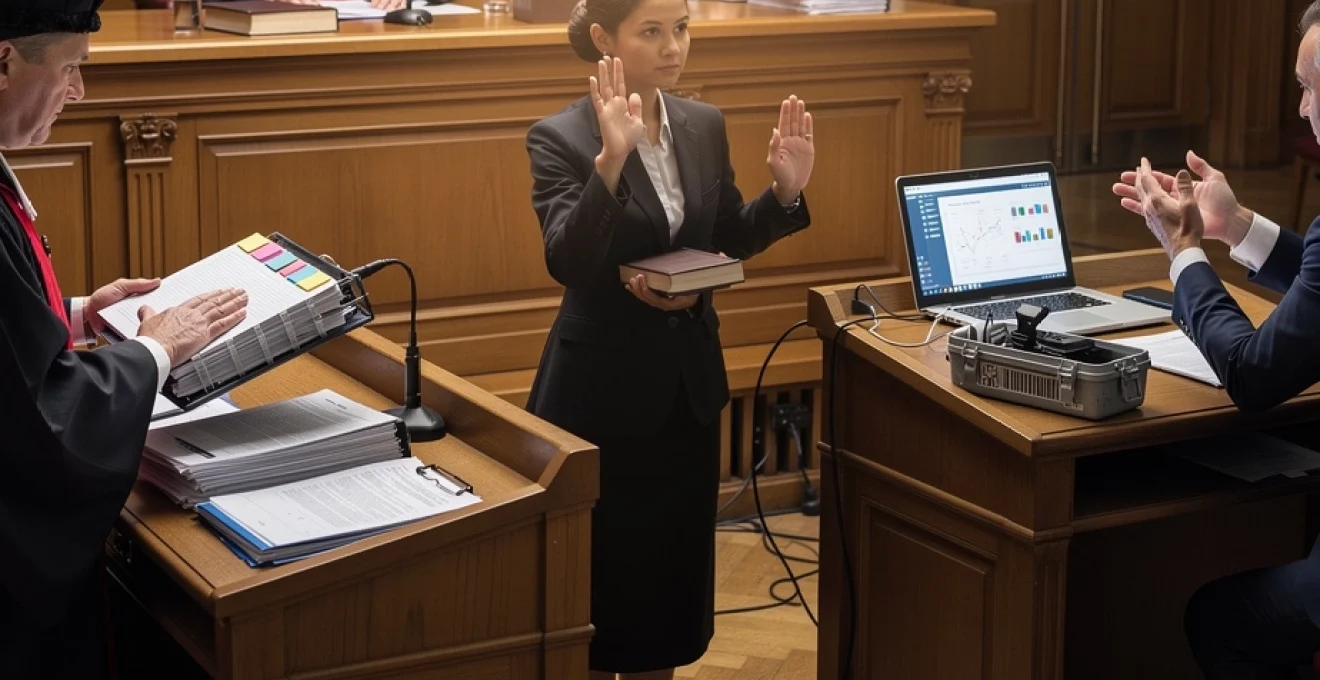
Before a witness gives oral evidence, they must swear an oath or make an affirmation, promising to tell the truth. This is usually administered by the usher, who will ask the witness whether they wish to swear on a holy book or make a non-religious affirmation. The wording is prescribed, and the witness simply repeats it line by line. It is a criminal offence to knowingly give false evidence once sworn in.
For many witnesses, this can be a daunting moment, particularly if they have never been inside a courtroom before. If you feel nervous or unsure, you can ask the usher or legal adviser to explain the process in advance. Children or vulnerable witnesses may use simplified oaths or be given additional support, depending on their needs and the nature of the case.
If a witness has difficulty standing or suffers from anxiety, they can usually sit while giving evidence, provided the judge agrees. The key point is that, whether you swear on a religious text or affirm, the obligation is identical: you are promising the court that what you say will be honest and accurate to the best of your recollection.
Examination-in-chief testimony guidelines under hearsay rules
The first set of questions a party’s own witness is asked is known as examination-in-chief (or evidence-in-chief). In civil proceedings, this is often limited because the witness statement stands as the witness’s main evidence, and oral questions simply clarify or update that written account. The advocate must avoid leading questions on disputed matters—that is, questions that suggest the answer—so that the witness’s evidence is genuinely their own.
Hearsay rules also shape how examination-in-chief is conducted. As a general principle, courts prefer direct evidence from someone who personally saw, heard, or experienced the relevant events. Statements made by others outside court can sometimes be admitted as hearsay, but strict conditions apply, and the court may attach less weight to them. In civil cases under the Civil Evidence Act and CPR, hearsay is more flexible than in criminal trials, but parties must still give notice if they plan to rely on it.
If you are a witness, you should focus on answering the questions clearly and honestly, without guessing or speculating. It is entirely acceptable to say “I don’t remember” or “I’m not sure” if that is the truth. Trying to fill in gaps can be more damaging than admitting uncertainty, particularly when the judge later compares your oral evidence with your written statement and other documents.
Cross-examination techniques and hostile witness declarations
After examination-in-chief, the opposing party has the right to cross‑examine the witness. Cross-examination is designed to test the reliability, consistency, and credibility of the evidence. Advocates are allowed to ask leading questions and may challenge the witness’s version of events, point out inconsistencies, or put alternative explanations. This can feel uncomfortable, but its purpose is to help the court reach a fair and accurate view of the facts.
From your perspective as a witness, the most effective approach is to stay calm, listen carefully, and answer only the question asked. If you do not understand a question, you can ask for it to be repeated or put in a different way. Judges are alert to aggressive or unfair questioning and will intervene if the tone or content crosses the line into harassment or confusion, particularly where vulnerable witnesses are concerned.
Occasionally, a party’s own witness may become uncooperative or give evidence that contradicts their earlier statement in a significant way. In such cases, the calling party may apply to treat them as a hostile witness. If the judge agrees, the party is then allowed to cross‑examine their own witness to challenge the unexpected evidence. This is relatively rare in most civil hearings but illustrates how the court system deals with situations where a witness departs dramatically from their previous account.
Expert witness testimony under CPR part 35
Expert evidence plays a central role in many modern court hearings, particularly in technical fields such as medical negligence, engineering disputes, or complex financial claims. Under CPR Part 35, experts owe their primary duty to the court, not to the party instructing them. This means that, in theory and practice, their role is to provide objective, independent opinion evidence within their area of expertise, rather than to “win” the case for one side.
Expert witnesses usually provide detailed written reports before the hearing, often followed by joint statements where experts for each side identify areas of agreement and disagreement. At the hearing itself, the expert may give oral evidence, responding to questions from both sides and from the judge. In some courts, procedural innovations such as “hot‑tubbing” (concurrent expert evidence) allow experts to be questioned together, helping the judge directly compare competing views.
If your case involves expert evidence, you should understand that judges are not bound to accept an expert’s opinion, even if it is technically sophisticated. They will assess factors such as the clarity of reasoning, the extent to which the expert has considered all relevant facts, and whether the opinion is consistent with other evidence. As a party, you should work closely with your legal team to ensure that any expert you instruct fully understands the issues in dispute and the court’s expectations under Part 35.
Documentary evidence authentication and chain of custody
Alongside oral testimony, documentary evidence—contracts, emails, medical records, photographs, CCTV, and digital data—forms a significant part of most modern hearings. For the court to rely on a document, it must be properly authenticated. This usually involves identifying its source, confirming that it is what it purports to be, and explaining how it has been stored and handled. In criminal and regulatory cases, the chain of custody for physical and digital evidence is particularly important, as any gaps can raise doubts about integrity or tampering.
In civil courts, many documents are admitted without dispute, especially where both parties have disclosed them during the pre-hearing process. However, if a document’s authenticity is challenged—perhaps an email is alleged to be forged or a photograph edited—the party relying on it may need to call a witness or expert (such as an IT specialist or forensic examiner) to explain how the document was created and preserved. Judges will consider these explanations when deciding how much weight to give the material.
From a practical perspective, you can help your own case by keeping clear, organised records and preserving original documents where possible. For digital evidence, such as text messages or social media posts, taking screenshots is a useful start, but more robust preservation—like downloading metadata or obtaining records directly from service providers—may be necessary in higher-value or contested cases. Think of the court as asking, “Can I trust that this document is genuine and complete?” Your preparation should be aimed at answering that question convincingly.
Judicial decision-making process and verdict delivery
Once all evidence has been heard, the court moves into the decision‑making phase. In civil hearings, advocates will usually make closing submissions, drawing together the key facts and legal principles, highlighting strengths in their own case and weaknesses in the other side’s. In criminal trials before a jury, the prosecution and defence present closing speeches, after which the judge sums up the evidence and explains the law to the jury.
Judges then retire to consider their decisions. In civil cases and hearings before magistrates or District Judges, this may result in an immediate judgment delivered orally on the same day, especially in shorter or simpler matters. In more complex cases, the judge may “reserve” judgment, delivering a written decision weeks or even months later. This written judgment will normally set out the facts as the judge finds them, the legal tests applied, and the reasons for the final outcome.
In criminal jury trials, the jury deliberates in private until they reach a verdict of “guilty” or “not guilty” on each charge. The standard of proof is higher than in civil litigation: the jury must be sure of guilt beyond reasonable doubt, whereas civil judges decide on the balance of probabilities. If the defendant is convicted, sentencing may follow immediately or be adjourned for reports; if acquitted, the case ends at that point, subject only to limited appeal options.
When judgment or verdict is delivered, the court will also address consequential matters such as costs, interest, and enforcement in civil cases, or sentencing and ancillary orders in criminal cases. You should listen carefully at this stage, as the judge may set important deadlines for payment, compliance with orders, or the filing of any appeal. If anything is unclear, you—or your representative—can ask the judge to clarify the terms of the order before leaving court.
Post-hearing procedures and appeals pathways
The conclusion of a court hearing does not necessarily mark the end of the legal process. After judgment or sentence, formal orders are drawn up and sealed by the court, setting out in precise terms what has been decided. These orders are usually sent to the parties electronically or by post, and you should read them carefully to ensure you understand your obligations and any time limits that apply.
If you have succeeded, the next step may be enforcement—for example, recovering a sum of money, ensuring compliance with an injunction, or registering a family order. Various enforcement mechanisms exist, from charging orders and attachment of earnings to warrants of control. Choosing the right method often depends on the debtor’s circumstances and the nature of the order. Legal advice at this stage can be invaluable in turning a “paper victory” into a practical outcome.
If you are unhappy with the result, appeals pathways may be available, but strict rules and tight deadlines apply. In many civil and criminal cases, you must first seek permission to appeal, either from the trial judge or from the appeal court. The key question is whether there has been an error of law, a serious procedural irregularity, or a decision that is plainly wrong on the evidence, rather than simply a result you disagree with.
Appeals are usually based on the existing record—transcripts, documents, and judgments—rather than new evidence, except in rare circumstances where fresh material could not reasonably have been obtained earlier. This means it is important to raise any concerns or objections during the original hearing, so they form part of the official record. If you are considering an appeal, you should act promptly: in many civil cases, the time limit is 21 days from the sealed order, and in criminal matters, it can be even shorter.
Specialised hearing types and tribunal variations
Not all hearings take place in traditional courts. Across England and Wales, specialist tribunals and regulatory bodies handle disputes in areas such as employment, immigration, tax, mental health, and professional discipline. While these forums share core features with court hearings—such as impartial adjudicators, evidence presentation, and reasoned decisions—they often adopt more flexible procedures and less formal settings to reflect the nature of the disputes they handle.
For example, Employment Tribunals and the Employment Appeal Tribunal operate under their own procedural rules, with a greater emphasis on accessibility for unrepresented parties. Similarly, the First-tier Tribunal (Immigration and Asylum Chamber) and Upper Tribunal have tailored processes for urgent appeals and sensitive evidence. In many tribunals, panel members include subject‑matter specialists alongside legally qualified judges, bringing practical expertise to their decision-making.
Special measures and adaptations are also more common in certain tribunal settings, particularly where vulnerable individuals are involved. Hearings may be conducted by video link, in private, or with the assistance of intermediaries to ensure that everyone can participate effectively. Time limits for appeals and reviews vary between jurisdictions, so if you receive a tribunal decision you disagree with, you should check the rules immediately.
Despite these variations, the underlying principles remain consistent: fairness, transparency, and the right to be heard. Whether you are attending a full trial, a directions hearing, or a tribunal appeal, thorough preparation, clear communication, and an understanding of the procedural framework will significantly improve your ability to navigate the process with confidence.